

Sudo Write – Is This the AI That Saves Your Manuscript?
You know what? When I first heard about yet another AI writing tool, I was skeptical. Really skeptical. I figured it would be great for, like, churning out a quick blog post about car insurance, but fiction? That’s a different beast entirely. That’s about nuance. It’s about the subtle ache in a character’s chest, the smell of rain on hot asphalt, the specific rhythm of dialogue that makes you believe these people actually exist. Could an algorithm really handle that? Turns out, Sudo Write is different because it’s not trying to be a jack-of-all-trades.
It’s built specifically for us: the folks who wrestle with plot holes, characters who won’t talk, and scenes that feel flat. It’s a specialized tool, kind of like a custom-made pen for a calligrapher – it just feels better in your hand for the job it was made for.
Let me explain the shift. Most general-purpose AI is like a brilliant intern; it can do a ton of research and write a competent report. But Sudo Write is like a seasoned fiction editor who’s also a creative genius. It’s tuned for narrative, trained on stories, and genuinely seems to understand what makes a scene pop. It even has its own special sauce model, ‘Muse,’ designed just for creative prose. That’s a serious commitment to the craft, isn’t it?
What Sudo Write Actually Does?
We all have those days, right? You sit down, you’ve got your outline, maybe a perfect cup of coffee, and then… nothing. It’s like the door to your imagination is locked from the inside. That’s where the best features of this tool come in swinging, and frankly, they’re pretty awesome.
Story Engine: Your Personal Plot-Pilot
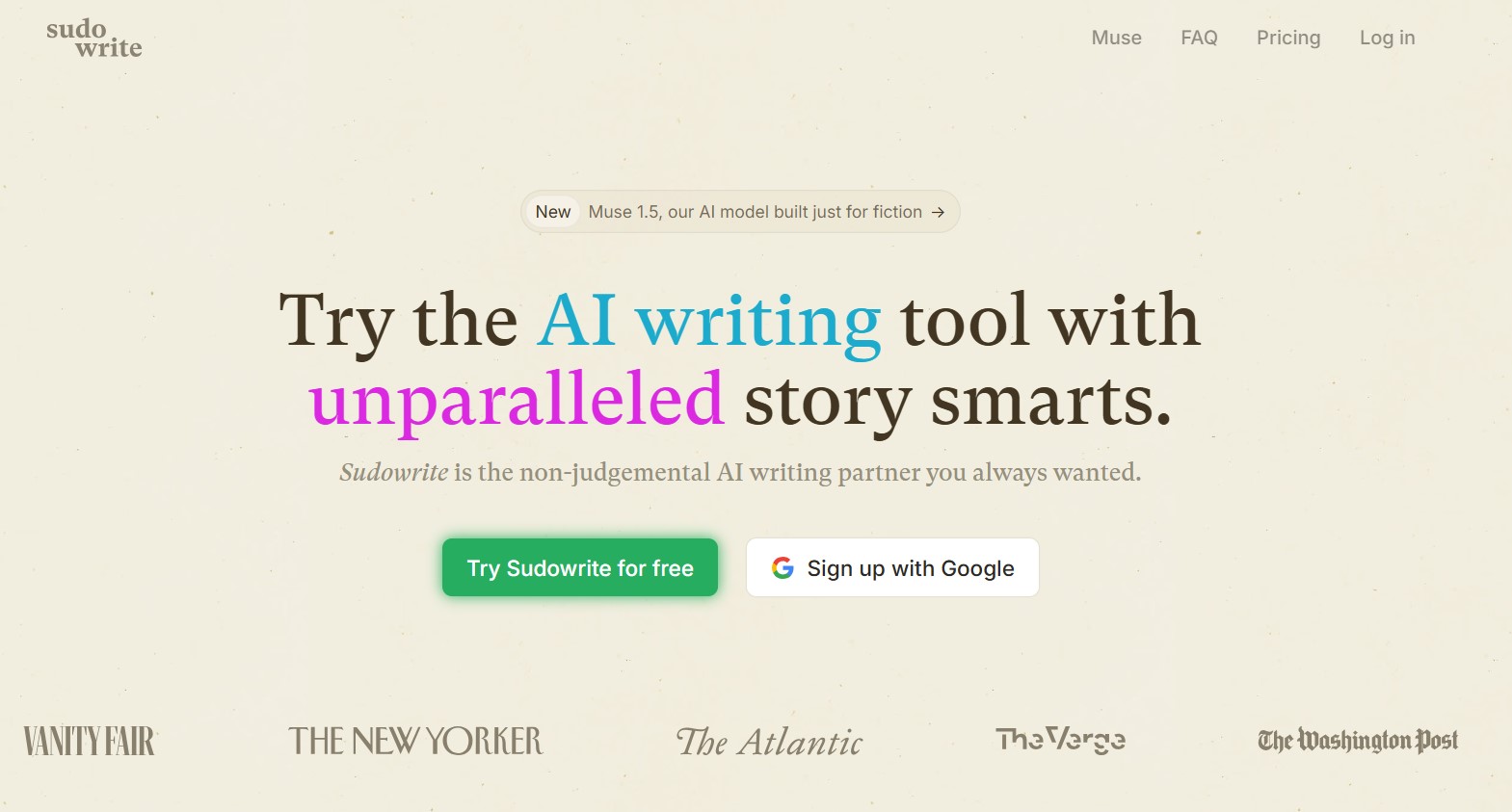
The big feature of the official Sudo Write website everyone talks about is the Story Engine. Honestly, it’s a lifesaver for people who are “plotters” but hate the work of plotting, or “pantsers” who suddenly realize they need a coherent ending.
Here’s what happens: you feed it the bare bones – your genre, maybe a couple of main characters, and the rough idea of your ending. Then, the Story Engine steps you through creating a Story Bible (your centralized notes for characters, worldbuilding, etc.), generating beats, and then finally, drafting whole chapters. It’s crazy fast.
I tried it with a messy idea I had for a sci-fi mystery. I put in a two-sentence synopsis, and within minutes, I had a structured outline. Of course, you have to go back and tweak it – it’s not a magic bullet – but think of it as laying the foundation of a house in an afternoon instead of a week. It gives you something solid to react to.
The Magic of the Describe Feature
You know how some writers, myself included sometimes, can be great at dialogue but terrible at description? We just “tell” the reader things instead of making them feel it. This is where the Describe feature is pure gold.
You highlight a sentence – say, “The room was scary” – and ask Sudo Write to describe it. It doesn’t just give you a fancy synonym for “scary.” No, no. It breaks it down by the five senses: sight, sound, smell, taste, and touch.
| Sense | Sudowrite’s Suggestion Vibe | What It Creates |
| Sight | Visual metaphors, light/shadow | “The air was the color of old blood under the single, bare bulb.” |
| Sound | Auditory texture, silence | “The silence wasn’t empty; it was a pressurized hush, waiting for a scream.” |
| Smell | Atmosphere, memory triggers | “A stale, metallic scent, like pennies and fear, clung to the corners.” |
| Touch | Texture, temperature | “The floorboards felt slick and cold, carrying a faint, skeletal vibration.” |
It pushes you past the obvious. Instead of just saying the room was dusty, it might suggest, “The air tasted faintly of forgotten metal and old paper,” pulling the reader right into that moment. That’s subtle emotional resonance, and honestly, that’s what we’re aiming for.
The Trade-Off: Where Sudo Write Needs a Human Hand
Now, I’m not going to sit here and tell you this thing writes literary masterpieces all by itself. That’s just not true, and you’d be foolish to believe it.
The thing is, the AI can occasionally veer off track. You might be writing a dark, moody thriller, and the generated prose suddenly gets a little too… purple. Or maybe your main character, who you established is a stoic, quiet type, starts cracking jokes like a stand-up comedian. You have to be the shepherd of the story. It gives you the raw clay, but you’re the sculptor:
- Consistency is a Catch: Even with the Story Bible, which is supposed to keep things on track, long-form narrative cohesion across dozens of chapters can be tricky. It’s like asking someone to remember a tiny detail from a conversation they had six months ago. The AI needs gentle reminders often.
- The Trope Trap: Like any language model, it’s trained on a ton of existing work. This means it sometimes falls back on common genre tropes. If you’re writing a fantasy, prepare for some predictable dragons or a magic system that feels a bit too “off-the-shelf.” The magic happens when you give it something weird to work with. Throw in an unexpected constraint or a strange character motivation, and that’s when the AI gets interesting.
A Peek Behind the Curtain: Comparing Sudo Write to the Others
Okay, so maybe you’ve tried ChatGPT, Gemini or something like Jasper. How does this stack up?
| Feature Focus | Sudo Write | General AI (e.g., ChatGPT/Claude) | General Content AI (e.g., Rytr) |
| Primary Goal | Fiction Writing, Story Craft | Conversational, General Knowledge | Short-Form Marketing, SEO Content |
| Special Features | Describe, Story Engine, Twist | Coding, Research, Summarization | Templates (Emails, Ads, Blogs) |
| Prose Quality | High-Quality Narrative (Fiction-tuned) | Versatile but often generic prose | Competent but can feel robotic |
| Credit System | Tiered Credits (Monthly) | Fixed Monthly Fee or Free/API Cost | Tiered Word Counts/Credits |
| Best For | Novelists, Short Story Writers | Brainstorming, Research, Quick Edits | Content Marketers, Bloggers |
Honestly, trying to write fiction with a general AI is like trying to fix a watch with a hammer. You can do it, but you’re going to make a mess. Sudo Write gives you dedicated tools. The Rewrite tool alone, which can change a passage to “Show, Don’t Tell” or “Add more internal conflict,” is something you just don’t get natively in a general chat model. That’s a huge pro for anyone serious about the craft.
Practical Tips: Getting the Most Out of Your AI Sidekick
How do you even start working with a tool like this? You don’t just hit ‘Go’ and wait for the Pulitzer. You need a rhythm:
- Don’t Start Cold. I’d suggest writing a paragraph or two yourself first. Give the AI a solid sense of the scene, the character’s emotional state, and the style. It will pick up on your voice, but only if you give it something to mimic.
- Be a Director, Not an Audience Member. Think of yourself as the director and the AI as your talented – but – unfocused actor. Instead of saying, “Write the next scene,” say, “Continue this scene, but the character needs to feel deeply uneasy, and the next physical action is them spilling their coffee.” Specific constraints lead to much, much better output.
- The Shrink Ray is Your Friend. We all get verbose sometimes. The Shrink Ray tool is fantastic for taking a paragraph that’s a little too much – maybe seven sentences when it should be four – and boiling it down to the essential tension. I find this especially useful in action sequences where you need tight, punchy prose.
But there’s a catch, you know? The biggest benefit of AI, speed, is also its biggest danger. If you rely on it too much, your own writing muscle gets flabby. Use it to get past the blocks, not to replace the thought.
The Emotional Calculus of AI: Can It Really Feel?
This is the big question, right? Can a machine capture emotional nuance?
Well, yes and no. The AI can absolutely use sophisticated language to describe emotion in a way that resonates. It can write a sentence that makes a character’s grief tangible: “The silence was the heaviest thing she’d ever carried, like a soaked wool blanket across her mouth.” That’s good stuff.
However, the AI doesn’t feel the emotion. It calculates the statistically most appropriate way to represent it based on millions of books. It’s a perfect imitator. Our job, the human job, is to be the emotional anchor – to make sure the emotion in that sentence connects correctly to the character’s history, their current situation, and the overarching theme of the story. It gives you a beautiful description, but you have to provide the authentic soul. The best writing, after all, is a subtle interplay between the technical precision of language and the warm messiness of human feeling.
Sudo Write Pricing
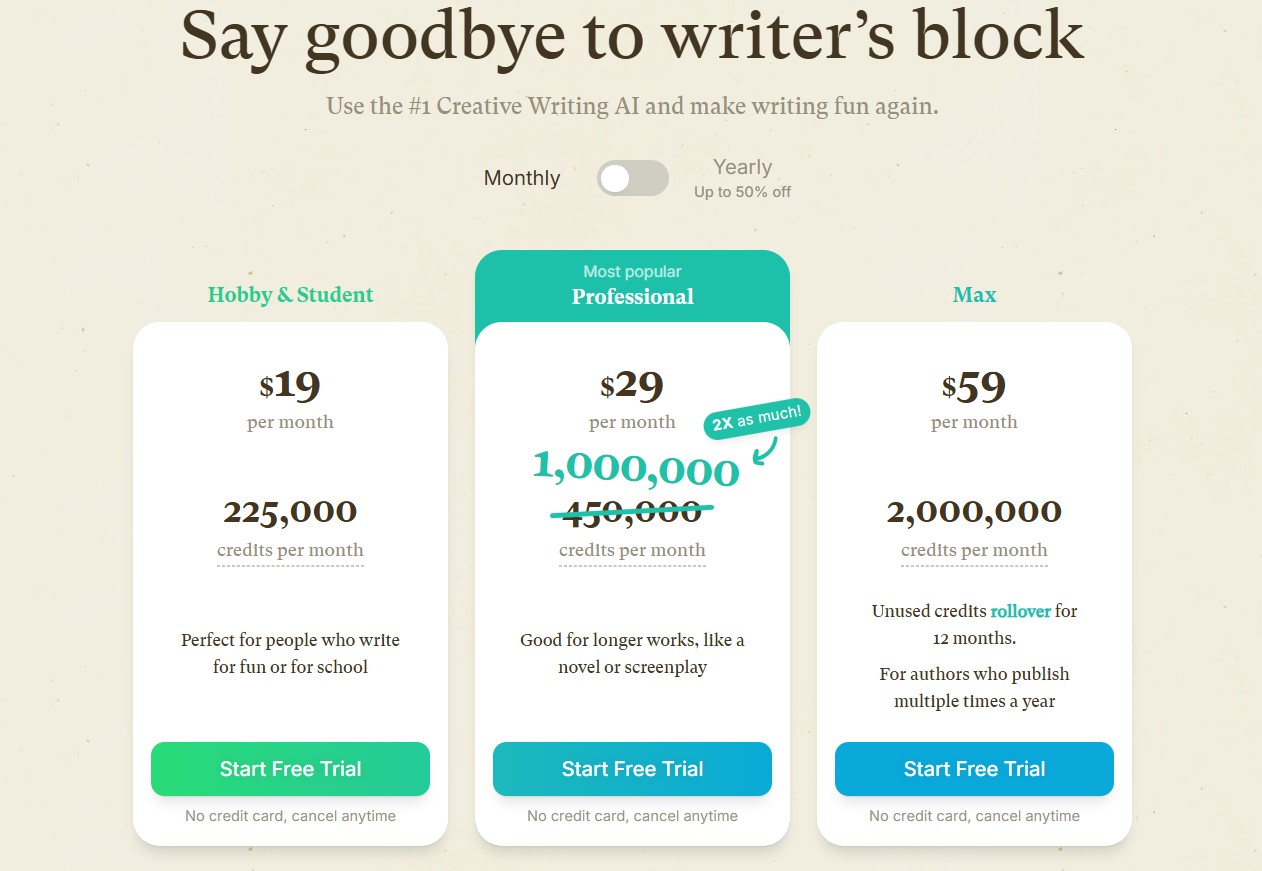
I get it. This is a tool you’ll probably be running quite often, especially if you’re a high-volume writer. Sudo Write runs on a credit system, which feels a bit like a video game currency, but it’s pretty transparent. More complex generations (like using their premium models or creating a whole chapter) simply cost more credits.
Here’s the lowdown on the annual plans, which honestly give you the best value if you’re serious:
| Plan Name | Monthly Cost (Billed Annually) | Monthly Credits (Approx.) | Best For… |
| Hobby & Student | $10 | 225,000 | Casual writers, students, and those starting a first draft. |
| Professional | $22 | 1,000,000 | Regular novelists, screenwriters, and consistent weekly work. |
| Max | $44 | 2,000,000 (Rolls Over!) | Power-users, authors publishing multiple works per year. |
A credit system actually encourages smart generation. You tend to be more careful, using the AI only for the tough spots or for high-value sections, rather than just hitting ‘Generate’ for everything. That’s a good thing, really, because it forces you to keep your hands on the wheel.
FAQ
Is Sudo Write going to steal my job?
No, absolutely not. Sudo Write is an assistant. It helps with the drafting and description parts that often lead to writer’s block. It doesn’t replace your unique voice, your life experience, or your overall plot judgment. Think of it as a ridiculously fast typist who is also pretty good at suggestions.
Does Sudo Write integrate with other writing software?
Right now, it’s primarily a web-based editor. You can import and export your work easily in formats like .docx or .txt. I usually draft inside their editor to use the tools, and then I export the final, human-edited version to my main writing program, like Scrivener, for organization.
What is the ‘Muse’ model I keep hearing about?
The Muse model is Sudo Write’s proprietary AI that is specifically fine-tuned for creative fiction. It’s supposed to produce more imaginative, less mechanical prose than a generic model like the base GPT versions. In my experience, it really does make a difference in generating unique dialogue and descriptions.
Can Sudo Write help me with non-fiction?
While it’s designed for fiction, the brainstorming and rewrite features can absolutely help with descriptive non-fiction, like travel writing or memoir. However, if you’re writing a highly technical or research-heavy paper, there are probably better, more fact-focused tools out there.
Do I retain the copyright to what Sudo Write helps me generate?
Yes, according to their terms of service, the writer (you) retains the copyright to the content created using the platform. Always a relief, right? It means the story is still yours.
How accurate is Sudo Write’s style-matching feature?
It’s surprisingly good, but not perfect. It will pick up on your sentence structures and vocabulary – for instance, if you use a lot of short, fragmented sentences, it will try to match that rhythm. However, it still needs guidance. If you notice it’s drifting, simply regenerate the passage with a clear note: “Keep the tone stoic and detached.”
Is there a free way to try Sudo Write?
Yes! They usually offer a generous free trial with a certain number of credits (around 10,000) so you can actually sit down and test it out on a scene or two before you commit to a subscription. Honestly, that’s the best way to see if it clicks with your personal writing style.
Final Thoughts: My Two Cents
Look, I’m a writer. I love the solitary process, the quiet joy of finding the perfect word after an hour of searching. I was ready to dismiss all AI tools as a creative crutch. But Sudo Write changed my mind. It’s not a replacement for talent; it’s a massive productivity booster and an idea sparker.
It’s the tool you go to when you’re stuck on a bridge of a scene, not knowing how to get across. It’s the tool that reminds you to describe the smell of the old bookstore, not just the sight of the dusty shelves. It makes the tedious parts of writing faster, freeing up your mental energy for the truly important stuff: the heart, the theme, and the authentic human drama.
If you’re a fiction writer, stop staring at the blank page. Seriously. Give Sudo Write a look, the MallorySoft approves. You might just find that your new best writing partner is a really clever piece of software.







+ There are no comments
Add yours